
6 Healthcare Technology Trends Accelerated By COVID-19 You Should Know

6 Healthcare Technology Trends Accelerated By COVID-19 You Should Know

6 Healthcare Technology Trends Accelerated By COVID-19 You Should Know

Technology is the need of time. This era is moving, or you can say running on technology. Think for a while, is there any field that is performing its tasks without this gift of science? The answer is a big NO! And if every field is dependent on technology, why health lags?

6 Healthcare Technology Trends Accelerated By COVID-19 You Should Know

During this pandemic of COVID-19, we have seen drastic changes in our lives. Similarly, healthcare technology trends accelerated by COVID-19 are also one of those changes.

Healthcare needs advancement because the survival of the human race is dependent on this sector. COVID-1 has proved that many developed countries do not have advanced healthcare systems. And their healthcare sectors collapse within two months of pandemic during 2020. 

So, the world has realized the importance of technology. Because it improves the efficacy of healthcare professionals and improves the outcomes of the performing tasks.

Here are the healthcare technology trends accelerated by COVID-19;

E-Hospitals

E-hospitals are established to connect the patients, doctors, and hospitals on a single digital platform that helps in providing services to the citizens with great efficiency. 

This concept is broadly accepted all over the world during the COVID-19 pandemic peaks, as we need social distancing in this pandemic. And E-hospital is the only solution for this.

Through these hospitals, anyone can reach any doctor across the world. The data can be shared through digital media. And consultation can be provided from far distances.

E-Pharmacy

E pharmacy services are the unique way of facilitating the citizens and are provided during this pandemic. As we are using online portals for shopping and home deliveries, medicines can also be purchased through online platforms. 

Websites and Apps are available on which you can find and order the medicines and disposable medical essentials, and order them online.

Telemedicine

Telemedicine is a service through which healthcare professionals provide online consultations through digital platforms. Many websites and Apps are working day and night to connect the patients with the doctors. 

These platforms have a complete database of doctors according to their specialties. You can also search for a health professional according to the disease you are suffering from. 

You don’t need to wait in long queues or waiting areas of the clinics, rather you can book your appointment online and get your consultation while sitting in your homes.

However, there are growing concerns regarding healthcare fraud and medical identity theft cases during virtual sessions. Fortunately, innovative solutions like RightPatient can prevent medical identity theft even during telehealth visits since it can be used at any touchpoint across the care continuum to verify patients’ identities.  

Artificial Intelligence

Artificial intelligence is enhancing the efficacy and outcomes of different health processes. It improves the diagnosis process, analysis, interpretation, and comprehension of complicated medical and healthcare data. 

It analyzes the data throughout the system. It helps in identifying the risks and infections. The data helps in predicting the future risks and healthcare outcomes.

Cloud Storage System

The storage system is like a cloud of data through which anyone can get information according to their need. A Cloud storage system in healthcare has all the necessary data stored in one place. 

And it can be accessible by anyone in the world. It is helpful in many ways like it is a cost-effective way of using the data and technology.

Wearables and Health-related apps

Covid19 led to wide usage of smart bands and health-related applications. The apps help in tracking your footsteps, workout, menstruation cycle, pregnancy, oxygen levels, heartbeat, and blood pressure, etc.

Similarly, people like to wear different smartwatches and bands to stay fit during this pandemic.

Living with the new normal is not that hard as it seems. If you just go with the flow and adopt the latest technology trends, you can easily survive this pandemic. 

Digital platforms like Marham are helping millions of peoples in connecting them with the best healthcare professionals while sitting in their homes. 

The website provides you a separate section of a health blog, in which you can read about the latest news related to COVID-19, health issues, remedies, best health professionals, and many more.

Now everything is just a click away in this online world. And you need to understand the benefits of these healthcare technology trends to get a better life ahead.
8-Strategies-That-Enhance-Safety-in-Hospitals-RightPatient

8 Strategies That Enhance Safety in Hospitals

8-Strategies-That-Enhance-Safety-in-Hospitals-RightPatient

Healthcare has always been under scrutiny by everyone, and it’s quite natural. After all, it is a system that has a direct impact on our lives. Diving deeper, one of the aspects that are examined thoroughly is safety in hospitals, and for good reason. For starters, hospitals are havens where the sick and injured ones among us go for treatment. Since critically ill patients are already vulnerable, they need to be guaranteed a safe environment so that their health doesn’t worsen, for instance, by contracting viruses.

8-Strategies-That-Enhance-Safety-in-Hospitals-RightPatient

However, patient safety is just one side of the coin – physicians, nurses, and other staff members also need to be guaranteed safety. Just think about the COVID-19 fiasco – a patient with the virus can just pass it on to anyone in the hospital who is without protection. Thus, safety for both patients and hospital staff members is crucial to ensure quality and safety in healthcare facilities.

While we just explained why safety within healthcare facilities is important, let’s take a closer look at how it can be improved – for both patients and the hospital staff members.

Strategies that enhance safety in hospitals 

Have a robust patient safety policy in place

One of the most crucial ways to improve patient safety in hospitals is by having a written policy in place. It must outline the do’s and don’ts regarding normal as well as emergency patient safety incidents that may potentially occur within the premises. Having such a plan is more crucial than ever, given the pandemic. For instance, what to do during outbreaks, what to do when a patient contracts a virus, and similar scenarios must be included in the plan.

Keep critical materials in stock at all times

Healthcare providers know how big of a challenge COVID-19 has been. In fact, it is still wreaking havoc across the US healthcare system as well as the rest of the world. Using PPE in the new normal is important, not only for the individual’s safety but also for everyone else around them. 

Hospitals, however, are places where PPE is an absolute must. While surgical masks, gloves, etc. have been used for years by physicians and nurses mostly, it is required by everyone within healthcare facilities.

Thus, keeping a healthy amount of quality PPE in stock is a crucial factor that impacts both patient and employee safety – it helps safely provide uninterrupted healthcare services. Moreover, reordering them when inventory drops to around 40% is a good strategy – remember, most of these materials are disposable!

RightPatient-enhances-patient-safety-in-hospitals-and-health-systems

Enforce safety measures on everyone on the premises

While there may be many individuals who might not like masks or other PPE, don’t let such behavior put your patients in jeopardy – it severely hampers safety in hospitals. Enforce rules within the healthcare facilities that apply to everyone. For instance, place posters on entrances and strategic places with messages that highlight the importance of masks as well as the fact that nobody is allowed to be there without proper PPE. Enforce social distancing as well, especially during patient registration, as many can forget about it during crucial moments.

Ensure proper waste management

This is a common but critical issue for any given healthcare provider, as most of them deal with discharges such as excretion, blood, etc. that might be contaminated. Properly label the trash cans or containers where these types of wastage go and also provide the employees with proper safeguards (masks, gloves, eye protection) so that they are safe while handling these materials. This won’t only help improve their safety, but the safety of everyone else they come in contact with.

Disinfect commonly touched surfaces and materials

COVID-19 has demonstrated how quickly and effectively viruses spread and how they stay on surfaces for an extended period. Ensure that beds, bedsheets, and any other surfaces are kept clean regularly. Also, use disposable glasses, plates, and materials whenever possible so that transmission is kept to a minimum.

Continuously work on improving safety

Ensuring safety once is not enough in such a rapidly changing environment – any responsible hospital or health system must take safety as a process rather than a task. 

Set meaningful targets to improve patient safety, tools to monitor them, and follow up to observe how you are doing. For instance, zero patient harm can be a huge challenge, but moving toward that goal and implementing the practices required for it can significantly reduce patient safety incidents.

Deploy solutions that boost patient safety in hospitals

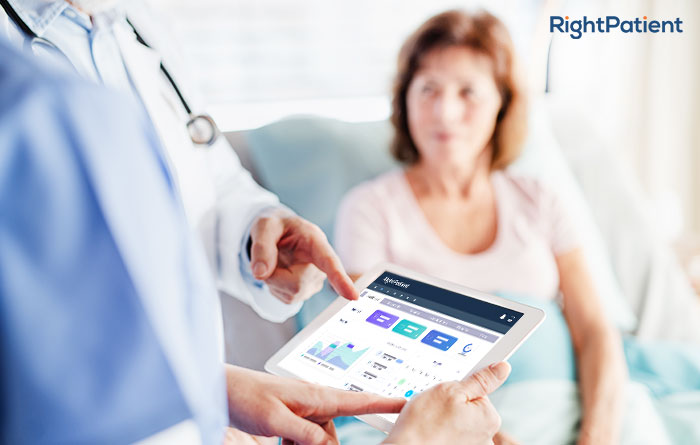
There are many solutions available that improve patient safety. However, one of the most crucial ones right now is RightPatient – a touchless biometric patient identification platform. But why is it needed so badly now?

Well, patient identification errors have been causing problems even during the pandemic and RightPatient solves that effectively. However, the best part is that it is entirely touchless, something that is a must in a post-pandemic world. All the patients need to do is look at the camera during – the platform attaches a photo and biometric data with the EHRs during registration. For subsequent visits, RightPatient runs a search when patients arrive and look at the camera, and provides the appropriate medical records in seconds. This helps to reduce HAIs (hospital-acquired infections) as there is no physical contact required. Moreover, patient safety is improved, medical errors are prevented, and healthcare outcomes are improved with RightPatient. 

Streamline OSHA compliance to improve employee safety

Hospitals have a lot on their plates as they must focus on employee safety as well as patient safety. Thankfully, CloudApper Safety, an OSHA recordkeeping software, can help with that. 

Employees can use it to share the best practices they deem suitable using their smartphones, and one of the main highlights is that the app can be used using mobile devices. Healthcare employees can report accidents, injuries, and near misses along with photos – helping streamline OSHA compliance. The management, on the other hand, can use all of the data, and work on corrective actions – improving safety in hospitals. It helps remove the administrative burden, streamline OSHA compliance, as well as reduce workplace safety incidents – enhancing safety for everyone involved.