
Identifying-patients-correctly-is-possible-with-RightPatient

CMS Compliance Requires Identifying Patients Correctly – Are you Ensuring it? 
Identifying-patients-correctly-is-possible-with-RightPatient

From the title, it is quite clear what this is about. The changes made to the Medicare CoPs (conditions of participation) have attracted attention within the US healthcare system, especially after the introduction of mandatory e-notifications during every ADT (admission, discharge, or transfer) of a patient. While providers are more focused on e-notifications, most of them forget about one very important prerequisite: identifying patients correctly. While we have already touched upon the topic regarding CMS (Centers for Medicare and Medicaid Services) Interoperability & Patient Access Final Rule, this time, we will focus more on the practical aspects and how patient identification is a crucial component that is absolutely necessary for e-notifications to work properly as well as CMS compliance. Without further ado, let’s dive deeper into the topic at hand.

Identifying-patients-correctly-is-possible-with-RightPatient

A brief refresher

A few changes have been made regarding the CMS Interoperability & Patient Access Final Rule. As the name suggests, it has been done to boost interoperability efforts within the caregivers of the patients. Let us look at why it is required within the healthcare system.

There are many cases where a patient is not restricted to a single healthcare provider;  especially if they have complications, multiple ailments and so on. Such patients need to visit and consult with multiple healthcare providers in order to receive the best patient care. For this to be effective, caregivers need to have access to the patient’s medical record, history, medications, vitals and other necessary information. In order to make the caregiving process seamless and boost interoperability, the Final Rule was introduced.

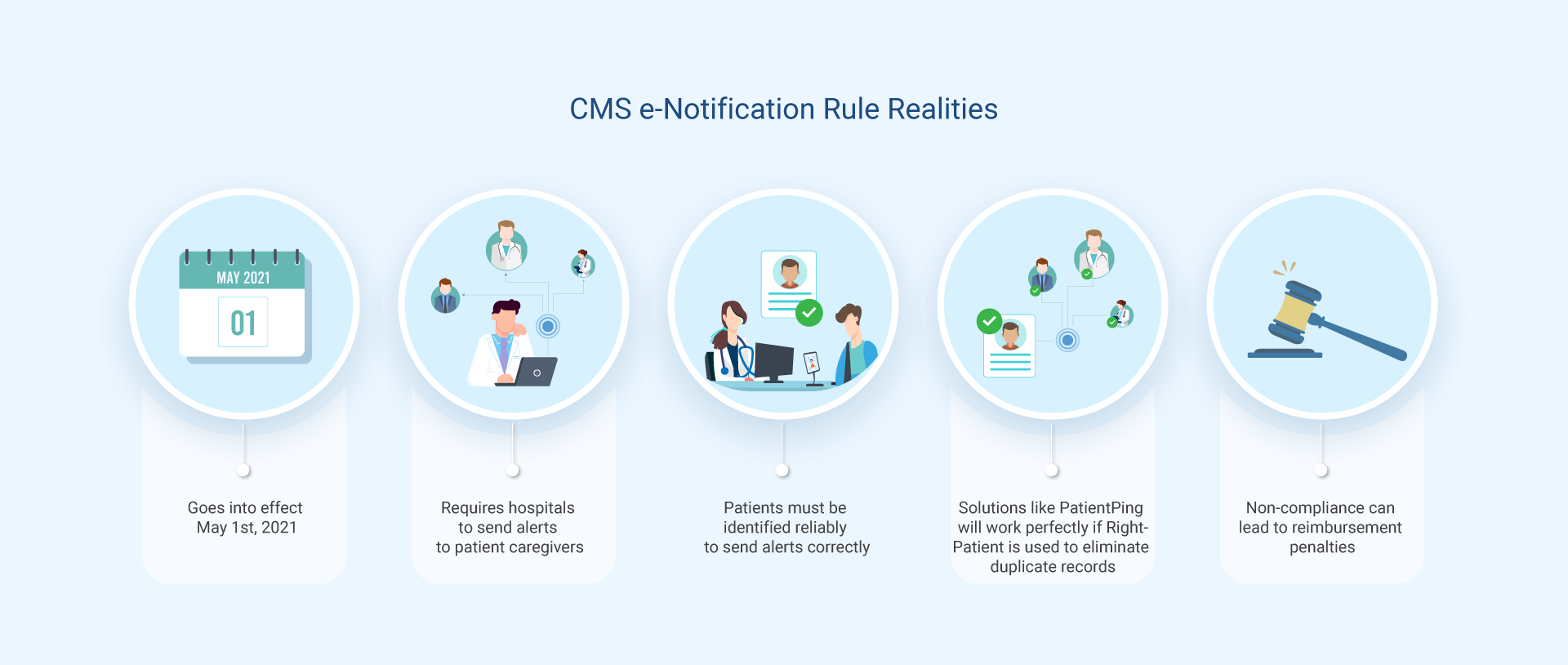
The “companion final rule” states that e-notifications must be sent out by healthcare providers (such as acute care, psychiatric, critical access providers, etc.) during every ADT to the appropriate recipients, i.e., the other caregivers (post-acute providers & suppliers, established primary care practitioners, or any other entity primarily responsible for the patient’s care). This rule applies to inpatient admissions as well as ED admissions. 

Who needs to ensure it?

Applicable healthcare providers are those who use digital medical records like EMR or EHR systems. They need to ensure compliance and have proper systems set up by May 1, 2021 so that they can send out e-notifications during ADTs. 
CMS-compliance-requires-accurate-patient-identification-RightPatient

While that’s a succinct summary of the most recent change in the CoPs, every healthcare provider needs to ensure that they are sending out e-notifications. Otherwise, they can face undesirable consequences such as receiving penalties for non-compliance, or worse, jeopardizing their CMS provider agreements. But how is identifying patients correctly related to CMS compliance regarding e-notifications?

Identifying patients correctly is required for CMS compliance

As previously mentioned, the CMS rule requires healthcare providers to send out notifications during ADTs. But there’s a catch.

Identifying patients correctly is quite important for e-notifications to work. Think about it: if a patient is not accurately recognized or is misidentified as a different patient, the healthcare provider risks sending alerts to the wrong caregivers. Worst of all, the provider risks that they won’t be able to answer alerts other caregivers are requesting.

Without a reliable way to identify patients, things can escalate quickly. If a provider cannot fulfill alert requests or sends too many incorrect alerts, care coordination teams will start to lose faith and miss opportunities to improve patient outcomes. Noncompliance will also incur CMS penalties, which can result in hefty fines. After COVID-19, nobody can afford such costs.
Ensure-accurate-patient-identification-with-RightPatient

While healthcare providers are busying themselves by deciding how to best implement e-notifications, they should also assess the effectiveness of their patient identity matching systems. Clearly, the former is dependent on the latter. Those who are struggling with patient identification need to upgrade their systems to futureproof, easy-to-use and hygienic ones. 

RightPatient helps identify patients correctly

We ensure that patients are always identified correctly with our industry-leading touchless biometric patient identification platform.

How it works

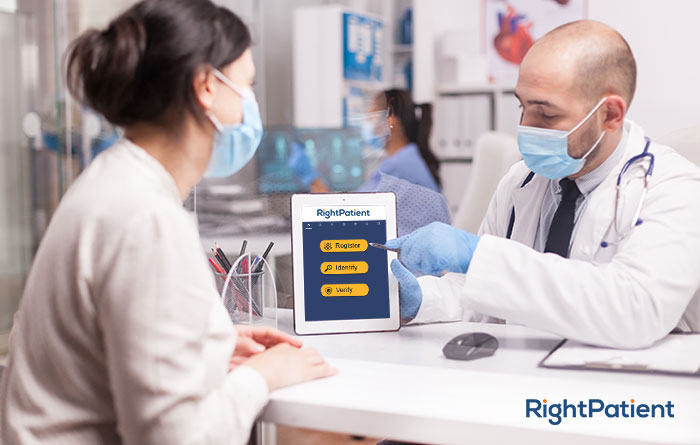
After making an appointment, patients receive an SMS or email to validate their identity. During this process, the patient takes a photo of their driver’s license and a selfie. RightPatient automatically matches the selfie photo with the photo on the driver’s license to ensure a proper identity match. If the patient is not already in the system, RightPatient assigns biometric credentials to the new patient.

This is how we prevent patients from registering under a different identity or medical record mix-ups. There’s no need to worry about name changes, mistakes when entering a patient’s name or other common issues. Patients are recognized with their selfies.

We have been helping prominent health systems like TGMC, CMC and CHSLI fight the battle against patient misidentification for years. With RightPatient, responsible healthcare providers can send e-notifications and comply with CMS without worrying about faulty alerts.

If we haven’t convinced you by now, why don’t you try our free trial? No gimmicks – it’s really free!


RightPatient-can-protect-patient-information-with-accurate-patient-identification

Providers Must Protect Patient Information to Enhance Patient Trust

RightPatient-can-protect-patient-information-with-accurate-patient-identification

The US healthcare system has always been the one attracting attention for all the wrong reasons – it is inundated with a plethora of issues. Lack of price transparency, interoperability issues, lack of proper patient identification, archaic laws governing the overall system, and prevalent medical identity theft cases are just some of the many problems that plague providers and prevent them from giving optimal patient care. One of the more prominent problems faced is healthcare data breaches – something that happens regularly nowadays. With the pandemic in mind, healthcare providers need to do all they can to enhance patient trust and improve patient safety – something they can do if they protect patient information. This is critical because it will boost inpatient volumes and can help offset the ongoing losses due to COVID-19. Let’s see how RightPatient can help by ensuring accurate patient identity verification.

RightPatient-can-protect-patient-information-with-accurate-patient-identification

What does the data say?

A recently released study by the Journal of General Internal Medicine has shed some light on patients’ perceptions about their EHR security and privacy.

According to the report:

  • The respondents who fear that their EHRs will be jeopardized due to a cybersecurity incident are three times more likely to hold back information from their caregivers, compared to those who do not share the same feeling, especially during the transmission of said EHRs electronically. 
  • Out of the respondents who trusted that their EHRs were safe and secure, chances of concealing information from their providers were around half compared to those who had privacy concerns.
  • Older, married, and employed patients were less likely to withhold information.

This study was conducted with keeping the growth of telehealth in mind and how a lack of patient trust will cause problems, especially during the pandemic. Thus, healthcare providers need to rethink their strategies and boost patient confidence. Not only will it help provide better healthcare services, but it will also increase patient retention – patients will not switch to other caregivers if they see that their providers protect patient information effectively.

Protect patient information by ensuring compliance

With the electronic transmission of PHI (protected health information), HIPAA compliance is the first thing that pops up on the minds of providers. The aforementioned study suggests the same: providers should address patients’ concerns by addressing security gaps. This can be done by providing proper training for internal data breaches and do’s and don’ts during PHI transmission, conducting internal audits to detect security issues, and keeping relevant employees on the same page regarding HIPAA compliance. HIPAA Ready is a robust HIPAA compliance software that can address all that and more, helping you protect patient information in the process. Simplify HIPAA compliance and reduce your administrative burdens with HIPAA Ready.

RightPatient helps protect patient information

RightPatient has been helping to protect patient data for years now. Moreover, even if you face a data breach, you can still safeguard patient information. Here’s how it works.

Once a provider deploys RightPatient, patients receive an SMS or email to validate their identity after scheduling an appointment. The patient provides a selfie and a photo of their driver’s license, and RightPatient matches the photos to ensure a proper match. Patients new to the platform are provided with new biometric credentials.Protect-patient-data-by-ensuring-accurate-patient-identification

 During inpatient visits, all patients need to do is look at the camera. The platform identifies them by matching the photos, ensuring accurate patient identification.

Another reason why RightPatient is a must

The aforementioned study is also related to the updated Medicare CoPs. Since the study talks about sending EHRs to other caregivers, the recently introduced e-notifications come to mind. With the looming CMS compliance deadline (May 1st, 2021), healthcare providers need to ensure accurate patient identification so that they can send out accurate e-notifications during ADTs. If they fail to send out notifications to the proper channels, it can cause noncompliance issues and can risk their CMS provider agreements. RightPatient is a must-have solution to avoid such cases and ensure that the proper caregivers are notified.

Contact us now to know how we can help you achieve your goals.

A-proper-patient-identification-protocol-including-RightPatient-can-mitigate-losses

A Futureproof Patient Identification Protocol Can Help Mitigate Providers’ Losses

A-proper-patient-identification-protocol-including-RightPatient-can-mitigate-losses

COVID-19 has been one of the biggest catastrophes to hit the world in modern times. There is literally no aspect of our lives it didn’t affect. Unfortunately, it will continue to affect us – experts are saying that the second wave is already here in the US. However, healthcare providers are still reeling from the ongoing surge of COVID-19 patients as well as the unprecedented losses faced due to the pandemic. With hospitals and health systems having to make hard choices like laying off employees, introducing pay cuts, and furloughing employees, is there any way to mitigate the losses? Yes, there are many, but the most sensible choice for providers would be to adopt a futureproof patient identification protocol like RightPatient. Let’s explore further.

A-proper-patient-identification-protocol-including-RightPatient-can-mitigate-losses

Hospitals expected to lose $323 billion in 2020!

And that is apparently an understatement. Losses might even exceed $323 billion, depending on the inevitable surges during the rest of the year as well as the increasing number of cases in some specific states.

The breakdown

During the final half of the year 2020, hospitals are set to lose at least $120.5 billion, especially due to lower inpatient visits, whereas an estimated $202.6 billion has been lost between March and June, according to AHA.

COVID-19 has affected all industries in the US, but its healthcare system is clearly the one it hit the worst – $323 billion is no small number. Since the pandemic started, hospitals had to reprioritize to deal with the surge of COVID-19 patients. Healthcare providers canceled elective procedures and non-COVID-19 patients were advised to use telehealth, reducing inpatient visits and leading to most of the financial losses.

Moreover, COVID-19 is causing hospitals to face higher expenses. PPE and ventilators, for instance, were not used as extensively prior to the pandemic. As previously mentioned, providers had to lay off employees, furlough them, or reduce their salaries, while others were even forced to close down due to the financial strain. Let’s look at some of the recent victims.

Healthcare-providers-are-facing-billions-in-losses-reduce-them-with-RightPatient

Some recent victims

BRMC (Bluefield Regional Medical Center) will be permanently closing down by July 30th, 2020. Financial damages due to the pandemic, lower patient volumes, and reimbursement rates were contributing factors that forced the officials to make this tough decision.

Saint Luke’s Health System will permanently close the doors of its Cushing Hospital in Kansas on October 1st, after closing down its inpatient unit on July 17th – another victim of COVID-19.

HealthPartners will shut down seven clinics and has stated that it will lay off 200 employees at two of those seven facilities. This, too, is because of the financial pressure brought by the pandemic. 

Suffering from financial challenges tied to the pandemic, UW Medicine will lay off 100 employees. This comes after it has already furloughed 4000 unionized employees and 1500 non-union ones. It has also received around $180 million in provider relief funding, but sadly, it looks like that will not be enough to offset the damages caused by COVID-19.

These are just some of the numerous cases that show the effects of the coronavirus pandemic on healthcare providers and how the pandemic is forcing them to make tough choices. Sadly, we are only halfway through this pandemic-driven year – we do not know what’s in store for us. 

Healthcare providers need to reduce costs significantly in order to survive this challenging phase – perhaps the most challenging one they have ever faced. So, is there anything that can help them mitigate their costs? 

An effective patient identification protocol can help

While healthcare providers are searching desperately for ways to reduce their costs, they can do so by preventing medical identity theft, avoiding duplicate medical records, and preventing patient identification errors. All they need to do is upgrade their patient identification protocol.

Before doing that, healthcare providers need to evaluate their current patient identification protocols.

  • Is it ensuring accurate patient identification across the care continuum?

  • Is it preventing medical identity theft?

  • Is it preventing duplicate record creation?

  • Is it ensuring a hygienic environment for patients and employees?

  • Does it have a high acceptance rate among patients?

  • Is it futureproof?

RightPatient-can-improve-patient-identification-within-your-healthcare-facilities

If even one of the answers to the questions listed above is no, then providers seriously need to upgrade their patient identity matching systems within their facilities. This is where RightPatient can help hospitals and health systems to reduce their losses and improve patient identification.

Achieve accurate patient identification with RightPatient

RightPatient is a photo-based patient identification platform that checks all the boxes for being an effective patient identifier. During registration, the platform locks the medical records of the patients with their photos. Returning patients simply look at the camera and are identified by the platform within seconds – providing the EHR user with accurate medical records. It also prevents medical identity theft, as fraudsters are red-flagged when they face the robust verification process. 

RightPatient prevents duplicate record creation, reduces denied claims, and prevents avoidable medical errors in the process to enhance patient safety.

Even before the pandemic, responsible healthcare leaders chose RightPatient because its touchless platform eliminated any chances of infection control issues during its usage – something that other conventional patient identifiers do not possess. RightPatient has over 99% patient acceptance rate – it provides a seamless, hygienic, and easy way for ensuring proper identification, improving patient safety and quality of care

The pandemic requires providers to switch to a touchless patient identifier and reduce healthcare costs significantly – try RightPatient now and experience the difference it makes.

Patient-identification-policy-can-be-simplified-with-RightPatient

Patient Identification Policy Impacts Data Integrity and Patient Safety Issues

Patient-identification-policy-can-be-simplified-with-RightPatient

Let’s face it – patient identification errors are nothing new and it is a much-discussed topic among healthcare leaders. For instance, just a month ago, a new coalition was formed to urge Congress to develop a UPI (unique patient identifier) to be used nationwide. Sadly, such formations are quite common – groups, competitions, and alliances have formed for years for the same reason. The result is that no UPI exists yet and patient identification errors are still wreaking havoc. However, many healthcare providers are reaping the benefits of accurate patient identification – it boils down to the patient identification policy used by the caregiver. Let’s take a closer look at how patient identification errors can cause a multitude of problems, why accurate patient identification is so crucial, and how platforms like RightPatient can help ensure just that.

Patient-identification-policy-can-be-simplified-with-RightPatient

Patient misidentification

It is quite self-explanatory. Patient identification errors occur whenever a healthcare facility fails to accurately match the patient with their appropriate medical record present within the EHR system.

It happens for a number of reasons. As already mentioned, it is nothing new and has been the result of years of human errors and improper patient data maintenance like duplicate medical records, overlays, and missing, incorrect, and/or incomplete information, leading to low patient match rates.

To put it into perspective, AHIMA stated that health systems can house up to 20% duplicate records within their EHR systems. The financial impact? It can go as high as $40 million for any given healthcare facility. 

Effects of patient misidentification

Low patient match rates is just the tip of the iceberg! Patient misidentification leads to several problems. Let’s look at the more prominent effects of patient misidentification.

Eliminate-patient-misidentification-with-RightPatient

Whenever you incorrectly identify a patient, it means that one patient’s data will get written into someone else’s medical record – creating patient data integrity issues. This leads to a lot of problems – incorrect medications, repeated lab tests, incorrect medical procedures, inaccurate patient history – the list just goes on. Both the patients will receive inaccurate care by the caregiver as a direct consequence of patient misidentification, hampering patient outcomes.

Naturally, patient misidentification leads to patient safety issues – these are bound to happen if your treatment is based on the wrong medical record. Consequences can be delays in treatment, worse patient outcomes, irreparable damages, and sometimes, patient misidentification can even result in deaths. According to a report by John Hopkins University, medical errors can cause up to 250,000 avoidable deaths per year, many of which happen due to patient identification errors. 

Thus, the million-dollar question is how can healthcare providers ensure accurate patient identification across their facilities?

It depends on a provider’s patient identification system

The accuracy of patient identification is as good as the patient identification policy used by the hospital in question, and there are many options hospitals can choose from. Responsible leaders, in any case, must choose the patient identification system that ensures accurate patient identification, provides a seamless experience, and provides a safe and hygienic environment for all involved.

RightPatient-can-be-used-for-younger-patients-as-well

There are a plethora of options available that hospitals can use as their primary patient identification policy. Sadly, many are still choosing the most obsolete one – inundating patients with questions. Whenever a patient arrives, officials ask them questions to find the correct medical record. This policy is slow, outdated, and extremely insecure – anyone can pass themselves off as the patient. In fact, this leads to medical identity theft – fraudsters buy stolen medical records from the black market and have all the information to pose successfully as the victim.

One other policy is to use patient ID wristbands. While this is a tad more secure than asking questions, it can still be taken off a patient and used for fraudulent purposes. Moreover, it is a contact-based solution, and that’s not something hospitals would want after the COVID-19 crisis – everyone is extremely aware of infection control issues now.

The most secure solution is using an identification policy where the identifier cannot be transferred or stolen – biometric modalities come to mind. There is a caveat though – patients would be quite reluctant to accept touch-based solutions such as fingerprint or palm-vein scanning.

Implement a touchless patient identification policy

The best option has been left for last – touchless patient identification platforms. RightPatient is the leading photo-based biometric patient identification system used by progressive healthcare providers.

Locking the medical records of patients with their photos upon registration, returning patients only need to look at the camera and the platform matches the photo with the one saved alongside their medical record, ensuring accurate patient identity verification.

There are many patient identification platforms available – be the responsible leader by choosing the one that shares the common goal of improving patient safety and quality of care at your facility.

RightPatient-ensures-patient-data-protection

Patient Data Protection is Ensured by Responsible Healthcare Leaders

RightPatient-ensures-patient-data-protection

Healthcare providers in the US have a lot on their plates. Even before the coronavirus pandemic, they had their hands full with issues like patient identification errors, cybersecurity threats, HIPAA compliance issues, an abundance of duplicate medical records, medical identity theft, a distinct lack of patient safety, and more. Whatever the case may be, progressive healthcare leaders need to ensure patient data protection at all costs. In fact, many of the aforementioned problems can be mitigated by protecting patient data – leading providers have been doing that constantly. But why is it so important? How can providers safeguard patient data? Let’s dive in.

RightPatient-ensures-patient-data-protection

Patient data protection

Safeguard-electronic-health-records-with-RightPatientPatient data protection has been one of the oldest and most important requirements for healthcare providers, and rightfully so – a patient shares critical and sensitive information with their caregivers. Names, Social Security numbers, dates of birth, contact information, addresses, facial photographs, medical history, and ailments are just some examples of the information stored within patient records. If these get compromised and land in the wrong hands, such cases can have disastrous consequences – healthcare insurance fraud, litigation costs for providers, and hampered patient safety are some common results. Thus, protecting patient data is crucial for any caregiver. Let’s take a look at a few more reasons why protecting patient data is necessary for hospitals and health systems.

Reasons to protect patient data

Ensuring Compliance

Concerns regarding data privacy are more common than ever – even more so when it comes to patient data. The frequency of healthcare data breaches proves that. However, providers, along with other healthcare organizations that deal with patient data, need to have safeguards in place to protect sensitive information.

Protecting-patient-data-ensures-compliance-RightPatient

HIPAA, also known as the Health Insurance Portability and Accountability Act, was introduced back in 1996 and is primarily used for patient data protection. It mandates that all healthcare organizations who deal with PHI (protected health information) must ensure that the data is protected at all times. If an organization fails to do so or violates HIPAA in any other way, they will face heavy scrutiny and hefty fines – up to $1.5 million per year. On top of that, the person committing the violation may face criminal penalties – fines and even jail time. Data breaches can cost up to $ 6 billion for the healthcare industry, and the US also tops the list of most expensive data breaches, besides Germany.

HITECH, or the Health Information Technology for Economic and Clinical Health Act, compliments HIPAA. It was created to make sure that healthcare information technology is adopted and utilized appropriately. Privacy and security concerns are addressed by HITECH as well.

Thus, patient data protection is a must to ensure compliance with the laws and regulations that are in place. While HIPAA compliance can be cumbersome and challenging, healthcare organizations can simplify compliance management and reduce HIPAA-related administrative burdens. There are solutions available to ensure HIPAA compliance – organizations should choose one that is simple but powerful and gets the job done effectively. HIPAAReady is such a solution. A robust HIPAA compliance software, HIPAAReady ensures training management and scheduling, reduces administrative burden, and keeps all HIPAA compliance documents in a centralized location. Organizations can even detect security gaps by conducting internal audits with HIPAAReady.

Preventing medical identity theft

One of the more crucial reasons why protecting patient data is so important is because failure to do so leads to medical identity theft. Let’s see how that happens.

RightPatient-helps-prevent-medical-identity-theft

Cybercriminals are always trying to breach the security of healthcare providers, and when they finally do so, they steal sensitive patient information and sell it on the black market for high prices. Fraudsters buy the data and assume the identity of the affected patients – committing medical identity theft, pushing off the expenses on the victims, and fraudulently obtaining healthcare services. 

Medical identity theft can lead to lawsuits, demand significant time and costs from patients and/or providers to rectify the issues, and compromise patient data integrity. That leads us to the next reason for protecting patient data.

Enhancing patient safety

Failure to maintain patient data integrity means that the data is not accurate anymore. When a provider fails to protect patient data, it leads to medical identity theft. When the fraudster uses the victim’s healthcare services, he/she contaminates the patient data – the fraudster’s data gets written onto the victim’s patient record, rendering it inaccurate. If such cases remain undetected or unfixed, they can severely hamper patient outcomes. Medical errors, delays in treatment, incorrect procedures, and even deaths – these are just some of the numerous consequences of compromised patient data. Thus, patient data protection is critical for enhancing patient safety.

Protect patient data now

Protect-patient-data-now-with-RightPatientProtecting patient data is a huge challenge, but it is achievable. One of the first and foremost things providers can do to protect patient data is to ensure positive patient identification at each encounter. That’s where we can help.

RightPatient is the leading patient identification solution chosen by progressive providers. It is a photo-based and touchless biometric patient identification platform with common goals shared by caregivers – to enhance patient safety, to ensure accurate patient identification, and to prevent medical identity theft

It locks the medical records of patients upon registration with their photos. Returning patients look at the camera and the platform matches the photos and provides accurate records within seconds. Even with healthcare data breaches, RightPatient protects your patients and their data as the platform will red-flag fraudsters during patient identity verification.

Protect patient data, prevent medical identity theft, ensure positive patient identification, and more – with RightPatient.