
How To Improve Patient Experience When Faced with Overflow

How To Improve Patient Experience When Faced with Overflow

How To Improve Patient Experience When Faced with Overflow

We all need to keep our patients happy, and it is paramount that you and your staff do everything possible to facilitate this. On a busy day when time is in short supply and your team is rushed off its feet, you may feel like all you are doing is making apologies. But, as long wait times have a negative effect on patient satisfaction, it’s crucial to eliminate the apologies and provide your patients with a good experience. After all, this may well determine how many repeat or referral patients you get in the future, which is fundamental if you want to grow your practice.

How To Improve Patient Experience When Faced with Overflow

1:  Communication is Key

Brushing up on how you communicate with your patients can improve their experience immensely. You should seek to understand how you can improve the experience of waiting and invest in developing patient-centered information and communication.

As a service-based business, you should be setting clear expectations for your patients. If you are having a particularly busy period and appointment times are stretched, make sure your team is aware that they will need to manage wait times. Be honest and up-front with patients if their appointment is delayed and provide them with accurate information about how long the wait may be. Patients can then decide if they want to wait, or they may prefer to rebook. It’s not a perfect solution, but it gives patients the choice.

Today’s technology is making it possible for patients and healthcare providers to communicate in ways we never dreamed of 20 years ago. Voice mail, faxes, and mail are giving way to instant messaging and telehealth video consults. Not only does this enable you to contact patients immediately if you foresee a problem that may result in their appointment being delayed, but it also reduces the time spent in the waiting room. In a pandemic, reducing potential exposure to the virus is beneficial not just for patients but for your team, too.

With all the means of communication we have at our disposal these days, there really is no excuse for not getting in touch with your patients. Unfortunately, technology does not teach individuals how to communicate with patients. Staff training in this area should be a priority as even the most technologically advanced communicator should ensure their face-to-face communication skills are equally as good.

2:  Revamp Your Waiting Room

The waiting room is a crucial part of a patient’s overall experience, and it should be welcoming, aesthetically pleasing, comfortable, and clean. A waiting room with tasteful décor, filled with color and natural light can influence patients positively on a physical and psychological level. It has been found that plants in the waiting room favorably impact patients and staff – even if they are artificial. Let your patients know you care about their experience by creating a modern waiting room aesthetic where your patients feel comfortable and able to relax.

Creating a Relaxing Space

De-clutter your waiting area by removing old magazines and keeping stacks tidy with baskets or magazine racks. Update your seating, choosing fabrics that are functional, comfortable, and match your brand aesthetic. Have a variety of ambient light sources in the room that contributes to a tranquil atmosphere much more than functional, overhead lighting.

Provide WiFi

Reliable, complimentary WiFi will be a huge benefit to many patients who can entertain themselves using their smartphones or tablets. Parents will find it useful to keep their small children occupied and for anyone needing to keep a check on emails or work, Wi-Fi will provide functional and practical service.

Customize TV Content

Customized TV content can deliver a variety of tailor-made messages to your patients. Far from just showing TV programs, you can create local interest content, such as ads from local businesses, or display information about your practice or dental health issues.

3:  Mitigate Long Wait Times with IT that Suits Your Business

Scheduling Tools

It is a common misconception that if you cannot see patients expediently, then it is because the practice is too busy. From time to time, this may well be the case, but one of the main reasons for limited appointment options could be due to inefficient scheduling. With the right healthcare scheduling software for your clinic, you can improve wait times for your patients and minimize staffing shortages that can contribute to overflowing waiting rooms.

  • For patients, filling in long forms in the waiting room should be a thing of the past. Digital health tools include portals that allow patients to fill in their information securely online before they arrive for their appointment – resulting in less time in the waiting room. What’s more, the information can integrate seamlessly with the dental management software suites you use to streamline other processes, such as administration, appointments, patient records, treatment planning, test results, billing. This saves you and your staff time so they can concentrate on patient care rather than administrative tasks.
  • For even greater improvements, staff shift scheduling can present your whole team with a valuable tool for managing their time. The fact is, you and your team must juggle patient waits, treatments, medications, insurance procedures and administration among other things and things can go awry swiftly if members of your team are absent. Shift scheduling software enables all members of your team to manage their work schedules and as practice manager for you to see at a glance who can step in to cover.

Telehealth

Although telehealth has been around for some time now, the pandemic has brought it truly into the mainstream. It is now an essential tool to aid communication between healthcare practitioners and patients, helping to keep patients and your staff safe and eliminating congested, chaotic waiting rooms. It has been estimated that 20% of emergencies can be seen using teledentistry, which itself can have marked improvement on congested waiting areas.

Artificial Intelligence (AI)

AI is already saving time for patients and for your staff. Rather than having to phone in and wait in line for your office to answer, a website chatbot can often answer questions frequently posed by patients – even out of hours. Additionally, it saves both your team’s and your patient’s time.

While AI is still in its infancy, machine learning will transform patient care in the future with algorithms that will be paramount in the way we treat patients – from diagnostics to holistic treatment plans. There will be numerous benefits to patients, including spending less time in a waiting room because AI-driven systems will be able to accurately detect their problems and prescribe a course of treatment.

The Bottom Line

In the world we live in today, patients have high expectations. They want to be seen with little wait times; they want their treatment options explained simply, and they want their dentist to be attentive and caring. Moreover, healthcare providers need to ensure that they are providing the appropriate treatment to the right patient. A touchless patient identification platform like RightPatient can help with that, preventing patient mix-ups, duplicates, and overlays in the process. 

Making improvements for your patients is just as likely to be beneficial to you and your team, too. The pandemic was not good for dental health and has already changed workflows dramatically with the increased use of technology solutions. But, moving forward it’s important to know your business and invest in the most appropriate technology and training that meets your practice’s needs, rather than the latest “cutting-edge tech” that may not fit in with your workflow.


RightPatient-addresses-many-patient-safety-concerns

Five Common Patient Safety Concerns Hospitals Must Address Effectively

RightPatient-addresses-many-patient-safety-concerns

Arguably, hospitals and health systems have been facing a very rough patch due to COVID-19, and with its latest variant, Omicron, it looks like it will continue to haunt everyone for quite some time. While COVID-19 is the biggest problem right now, it’s not the only one – healthcare providers need to address several issues to treat patients effectively and safely. With that out of the way, let’s dive deep into some of the typical patient safety concerns hospitals need to address effectively.

RightPatient-addresses-many-patient-safety-concerns

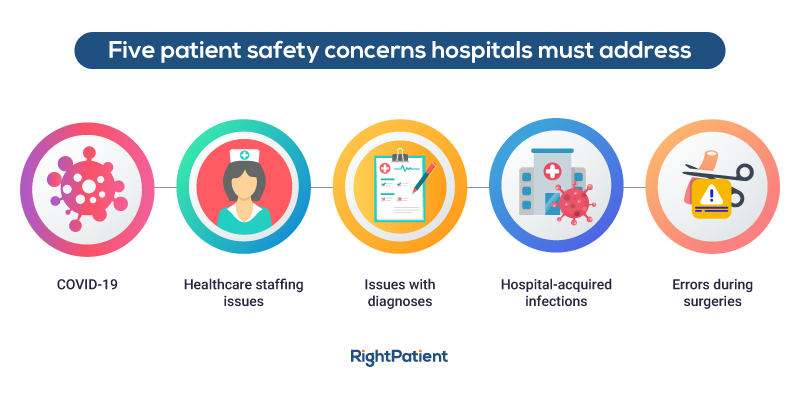
Five patient safety concerns hospitals need to focus on

COVID-19

Quite unsurprisingly, this tops all lists regarding patient safety concerns in the world now. This has been the most significant and unprecedented challenge healthcare providers have faced in recent years. Even with the new vaccines, rules and regulations, cases are still increasing due to the Omicron variant. 

The variant has caused several hospitals to permanently close their doors, rapid changes to the entire healthcare landscape, incorporation of telehealth into the mix and adoption of other practices – desperate times call for desperate measures. 

While hospitals have already allocated or built separate facilities to accommodate COVID-19 patients, surges created by new variants have overwhelmed them. During such surges, hospitals postpone non-emergency elective procedures and surgeries, limit visitors, shorten visiting hours and encourage telehealth to protect regular patients from catching COVID-19 at their facilities. While these have become the typical responses, it disrupts the healthcare experience for many patients – what if the non-emergency procedure is crucial for the patient, or what if the hospital suspends ALL elective procedures? These are some questions that need answers from healthcare providers. 

Healthcare staffing issues

The virus has led to another problem – a shortage of healthcare professionals. Many professionals contracted the virus. Unfortunately, some lost their lives, and others had to isolate themselves. On the other hand, hospitals incurred huge losses since elective procedures and regular healthcare visits were postponed or canceled. They had to furlough or lay off workers and introduce pay cuts. These actions led to massive shortages as nurses and other healthcare staff members had to look after far more patients than they could manage. 

Five-patient-safety-concerns-hospitals-must-address-RightPatient

This is a huge patient safety concern because fewer healthcare staff members mean that the treatment will be rushed and compromised. Patients won’t receive the level of care they need, and increased pressure on healthcare staff members might lead to mistakes.

Issues with diagnoses

While diagnostic errors were common before COVID-19 wreaked havoc, the virus has caused many patients to miss out on scheduled diagnostic tests or even have them delayed. In the pre-pandemic era, errors such as delayed diagnosis, misdiagnosis and failure to diagnose related diseases were common. However, healthcare providers were forced to delay all procedures barring COVID-19 cases to allocate resources to deal with the pandemic.

Due to such delays, the patients’ health problems worsened, leading to more complex treatment plans, higher risks and chances of patient safety incidents. Once again, healthcare providers are using telehealth to address this issue. Although diagnostic tests are virtually impossible, patients need to physically come to healthcare facilities for the tests.

HAIs – one of the most significant patient safety concerns now

Hospital-Acquired Infections (HAIs) are quite problematic and have become one of the prominent patient safety concerns in the US, especially after COVID-19. Hospitals consist of patients suffering from different diseases, some of which are contagious. When other people, be it patients or healthcare staff members, have contact without ample protection, they’ll contract the virus as well. This is how COVID-19 has spread, and healthcare providers need to use innovative solutions and strategies to prevent HAIs. For instance, touchless patient identification platforms like RightPatient can help with infection control and reduce HAIs effectively – more on that later. 

Errors during surgeries

Surgical mistakes are one of the biggest challenges for most healthcare providers. Surgical errors come in various forms, from retained surgical instruments and wrong-site surgery to operating on the wrong patient. A frequent surgical mistake is when patients get mixed up due to common names. While there are miraculous cases where the initial patient survived, these are dangerous nonetheless.

Surgical mistakes due to patient misidentification can be prevented with a tried and tested biometric patient identification like RightPatient. Using their photos, it ensures that patients are identified accurately and safely across the care continuum.

RightPatient prevents duplicate medical records and mix-ups – preventing patient safety incidents in the process. 

How are you addressing patient safety concerns at your healthcare facility?

Easier Ways to Guide Patients to Healthcare Services

Easier Ways to Guide Patients to Healthcare Services

Easier Ways to Guide Patients to Healthcare Services

In the healthcare industry, it is extremely crucial that patients can easily find the right information at the right time to ensure the highest quality of Healthcare Services. Here are some tips to make crucial information easier available online.

Healthcare communications are becoming a crucial part of making sure the patient will get the right treatment. Quick access to the right information can be crucial for starting the right treatment, even before the patient will encounter the healthcare system. Therefore, providers in the healthcare industry can take a service check on their online services to make sure that the most important information is easily available to patients.

Easier Ways to Guide Patients to Healthcare Services

Avoid Specialized Language

A primary task in healthcare information is to convert medical terms into simpler terms that can be understood by laymen. Few of the patients have the right education to understand the doctors’ language and will probably not obtain it before it becomes crucial information for the patients. The main task here is to simplify without giving wrong information.

Use Easy-to-remember Intuitive Domain Names

When a patient sees a doctor and gets advised to read more information on a webpage, it’s important that this webpage is easily accessible. Some companies tend to have special shortenings of names that are difficult to either spell or remember for the patients. Therefore, it can be useful for health care services to use a premium domain name.

A premium domain is living up to the criteria for a user-friendly experience. Such domains might already be occupied or bought by other companies. But at Domainify, you can find some of the best healthcare domain names. These names are all living up to the criteria for a premium domain name, and it even comes with a pre-designed logo. It is even SEO-friendly and all of them are easy to remember and spell for patients.

Make Communication More Visual

Medical terms can be abstract and difficult to understand for patients. Many people don’t know about the body’s mechanisms. They can feel pain and discomfort but might not know exactly how a knee or stomach is functioning. Therefore, doctors and health care personnel have a big task of communicating this information in an easily understandable way.

For a lot of patients, descriptions of the body can be quite abstract in words. Often a feeling in the body is difficult to translate into words. This is leading to a huge potential in visual communication like infographics in health care. Here health care providers can more easily give instructions, communicate about specific body parts or symptoms.

The brain is processing visual communication thousands of times faster than text according to TechSmith. Research also shows that people are more likely to remember communication when it is delivered visually instead of by text. The explanation is not so weird. Visualizations show things like they are. Text is a transformation of events in the world transformed into letters, that are forming words, sentences, and texts. Texts might be easy to write, but visuals are easier to use for learning.