
RightPatient-can-reduce-hospital-losses

Hospitals Might Lose $122B – Can a Robust Patient Identification System Help?

RightPatient-can-reduce-hospital-losses

Healthcare providers in every nook and cranny of the world have had their hands full with COVID-19 dealing damage everywhere. The US was not left out as its healthcare system could not cope with the unexpected events that persisted when the virus hit hard. The loss incurred in 2020 was massive for healthcare providers and difficult decisions had to be made. Unfortunately, the year 2021 doesn’t look like much of an improvement. The Kauffman Hall report suggested that healthcare providers could end up losing as much as $122 billion in 2021 in the worst-case scenario. On the less pessimistic side, they will lose up to $53 billion, which is still a significant amount. That being said, we need to look in-depth at how the impact could be reduced significantly and how the administration of an effective patient identification system can reduce significant losses.

RightPatient-can-reduce-hospital-losses

Loss is inevitable for most healthcare providers in 2021

The major difference between 2020 and 2021 is that now people are getting treated with vaccines against the devastation that was the theme of the previous year. Most hospitals have opened up and there is a gradual decrease in the amount of COVID-19 cases. Hospitals will, however, have to settle for a loss of about 10%, which is still considered a pretty serious loss by experts.

Patient identification errors are still plaguing health systems and, even before the pandemic, there had been huge losses for caregivers. But not all of them were suffering from the losses.

NYU Langone Health, Baylor Scott & White Health, the Mayo Clinic, and some others are just some of the large hospitals that benefited from a bout of federal healthcare bailout grants. Baylor Scott & White, in particular, earned profits in 2020. Many others didn’t come off with such luck as they had to shut their doors permanently, lay off most of their workers, introduce pay cuts, and furlough employees. The losses have further extended into 2021 and it could persist into 2022. The focus must. however. be shifted to existing problems – ensuring positive patient identification is one of them.

How an effective patient identification system helps reduce losses

The major strategy which healthcare providers are using to mitigate losses is by cutting expenses. Reducing the workforce shouldn’t be a priority as they could focus on solving problems associated with patient safety problems, medical records mix-up, duplicate medical records, patient outcomes, denied claims, preventable medical errors – the list goes on. The cord that connects them all is patient identification errors. 

RightPatient-is-the-leading-patient-identification-system

Poor identification of patients will cause hospitals to administer wrong treatments that often result in patient safety incidents, harmful patient outcomes, readmissions, etc. There is a consequential ripple effect of patient misidentification on hospitals and patients alike. These effects can be too heavy and costly on either side. Preventable medical errors, denied claims, litigation costs, and fixing duplicate medical records can lead to massive losses for any healthcare provider. An effective patient identification system must be adopted by hospitals – RightPatient is the best fit for the task.

RightPatient is the leading patient identification system

RightPatient is a touchless biometric patient identification platform that solves the problems plaguing healthcare providers and patients nowadays. It is just what we all need in this post-pandemic era. It is easy to use and hygienic for both caregivers and patients due to its touchless nature. RightPatient can help to prevent losses in millions by preventing patient misidentification, medical identity theft, denied claims, duplicate medical errors, etc. It is a must-have for responsible healthcare providers to reduce losses and enhance positive patient outcomes.


Current-Challenges-in-Clinical-Research-RightPatient

Current Challenges in Clinical Research that Hamper Trials

Current-Challenges-in-Clinical-Research-RightPatient

Clinical trials have existed for a long time but they became even more important when COVID-19 raged. Traditionally, all vaccines, medical devices, and beneficial drugs designed for specific diseases are created by carrying out intensive tests to ascertain their safety and viability in treating the disease through clinical trials. The process of a clinical trial can be excruciatingly long and laborious with several factors that could deter its progress and success. We will discuss the notable challenges common to clinical research, how it affects the process and the results of clinical trials, how sponsors and Principal Investigators (PIs) leave crucial issues out unsorted, and how to best take advantage of patient identity verification.

Current-Challenges-in-Clinical-Research-RightPatient

Preventing professional patients is possible with RightPatient.

Current challenges in clinical research 

Arduous, dangerous, time-intensive, and complex are the words that can fully capture the nature of the process that surrounds clinical trials. The trial is supervised by Sponsors and PIs to ensure that there are no violations of the rules and regulations to the letter such as the enrollment of the right amount of patients that fit the required conditions for the trials. They are also tasked with the stringent management of several trial sites. Here are some of the challenges that oppose the success of clinical trials.

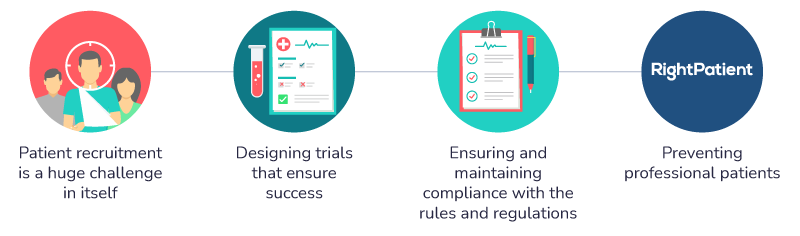
Patient recruitment can pose a huge challenge

The most recurrent aspect in the list of current challenges in clinical research that often occurs right from the conception of the idea of a clinical trial is the issue of patient recruitment. Some of the problems, in this case, include the unresponsiveness of patients, the attraction of patients with conditions that do not fit the subject of the test, or poorly performing research sites. These could end the clinical trial before it even starts. If we are to delve into the lengthy list of the challenges of patient recruitment, it would take an entirely different article of its own.

The focus here is that there can be no clinical trial if test subjects are not available or they do not fit the criteria for the trial. The problems that may arise from the trials may result from the fact that research data was not enough to affirm the drug/vaccine’s effectiveness. Irrespective of the promising nature of the agent, the drug may fail to progress to the subsequent phases necessary for approval for general use.

Designing trials that ensure success

The process of designing a successful clinical trial is also one of the top challenges because it has to satisfy everyone. At the start, it was not so complex, all rules and regulations were often in their infancy, and things were always pretty easy.

RightPatient-prevents-professional-study-subjects-in-clinical-trials

Current challenges in clinical trials – RightPatient addresses the overlooked one.

Modern clinical trials, however, have taken on a new shape of complexity with rules that must be adhered to from top to bottom. It must be simple for patients to understand and obey, it must proffer answers to rather difficult questions in the right way, and ultimately, it must satisfy the necessary stakeholders. Meeting expectations in a trial design is not easy. This makes it one of the most consistent of the current challenges in clinical research.

Ensuring and maintaining compliance with the rules and regulations

The healthcare industry is a highly monitored sector because of the gravity of the healthcare outcomes of patients in the system. The subsequent products of clinical trials such as drugs, vaccines, treatment processes, and medical devices represent outcomes, they are also subject to heavy regulations.

The existence and importance of the regulations are relateable but it also makes for a herculean task in strict compliance. The slightest discrepancy could hinder the trial and lead to a huge financial loss running up to millions. Maintaining and ensuring compliance remains a great challenge with unlimited imposed regulations.

Preventing professional patients

Professional patients is not a commonly discussed term whenever issues related to current challenges in clinical research are raised. Nonetheless, it is also a crucial issue. It goes by different terms like “professional study subjects” and “duplicate study subjects”, and they are individuals who are capable of thwarting the credibility of clinical trials. They are culpable for participating in multiple trials simultaneously or consecutively, thereby influencing ruining the overall results of the trials that follow.

A relevant illustration is that of a duplicate study subject that has been diagnosed with a heart condition and has participated in a trial and received dosages of an experimental drug. The subject then goes almost immediately to partake in another trial. The problem lies in the fact that the initial drug is still in their system and it will project wrongly on the second trial. There is also the danger attached to going to multiple trials as it will not only skew the results of the trials but will also be harmful to them.

These types of patients affect the integrity of clinical trials while also presenting a danger to their health. In addition, they could lead to losses worth millions and can lead to experimental agents being deemed as failures because of skewed results. Fortunately, RightPatient can prevent

If you are looking for the right tool to help in dealing with professional patients in clinical trials, you can count on RightPatient. It is a trusted touchless patient identification platform that has earned great reviews from top healthcare providers. It has ample capabilities and experience that could put an end to issues of professional patients effectively. The platform could help to save millions worth of losses, and mitigate delays in approvals, and enhancing the integrity of trials. RightPatient is the perfect way to prevent professional study subjects in clinical trials.

How Technology Improved Road Accident Data Collection

Accidents are one of the leading causes of death worldwide. According to WHO (World Health Organization), approximately 1.35 million individuals lose their life in car-related crashes every year.

In the USA alone, more than 38,000 people succumb to vehicular crash injuries. Accident data collection is a crucial exercise and should be done with utmost caution. Involved authorities have developed advanced techniques to collect and analyze data after a crash. 

Read the following article to understand the importance of data collection and some of the advanced techniques used to collect accident information. 

Common Causes Of Accidents

For many years, accidents have been claiming innocent lives all over the world. Some of the main causes of automobile accidents include:

  • Distracted driving – according to studies, this is one of the main causes of accidents. 
  • Driving while under the influence of drugs and alcohol
  • Over speeding
  • Ignoring road signs
  • Careless driving
  • Fatigue

On the other hand, accidents can be caused by factors unrelated to human error, and they include: 

  • Weather conditions
  • Poor roads, for example, potholes
  • Mechanical failure

Importance Of Accident Data Collection

  1. Information collected is important in a court of law – jury and auto accident lawyers will use the provided information to prove what or who caused the crash. 
  2. The authority will use the data to mark high-risk areas commonly called ‘blind spots’ and make the necessary construction improvements to prevent future accidents.
  3. The government may use the information to raise public awareness of safe driving. People are discouraged from overspeeding, drunk driving, and other causes of accidents. 
  4. The government may also use the data to improve Emergency Medical Services. This may reduce the number of fatalities in an accident.

Latest Accident Data Collection Techniques

Over the last few years, there was a need to improve traffic management, which led to the advancement of accident data collection methods with access to real-time traffic data which is becoming a routine worldwide.

Some of the traditional data collection methods, such as interviewing witnesses, have been in use for many years. Although police can gain information involving a crash through this method, it may not be sufficient to determine the cause of an accident. One major drawback of this method is that the human brain is prone to forgetting and he or she may leave out crucial parts giving inaccurate information.

After many years of research, there was the development of much better techniques of data collection with the use of technology. These methods proved to be efficient as compared to the traditional techniques used to collect accident data. They include: 

Use Of Event Data Recorder

EDRs were usually associated with planes, but in recent years, many car manufacturers fit their cars with EDRs. The EDR (Event Data Recorder) is a recording gadget made from a long-lasting and impact-resistant material. It records everything before an accident occurs.

Police and detectives can use the recorded moments leading up to a crash to determine what caused the accident so that they steer clear of similar events in the future.

  • What Is Being Recorded By The EDR

A black box will record crucial information such as the speed of the car, where the throttle was positioned, airbag deployment, application of the brake, and several other factors as they were 20 seconds before and after the accident.

The information will be used to determine whether the crash was caused by a mechanical failure or an avoidable human error. 

Accident Reconstruction

This is another latest technique used by investigators and police to collect information leading to a car accident. It involves recreating the collision scenes using 3D laser scanning to determine the factors that caused the accident.

The development of laser scanning made it easier for authorities to collect accident data in a safer way, as they can collect the information without disrupting the transport system by closing lanes. It’s also a fast and flexible way to collect information as one person can control the entire system. 

The information collected through the recreation of the accident can be used in a court of law. 

Use Of Biometric

In recent years, biometric has become another popular way to collect accident data. It was used when people involved in the accident were unconscious. It involves using physical and behavioral attributes to identify an individual digitally. 

Some of the physical attributes to identify a person and get their emergency patient ID include:

  • Veins
  • Iris
  • Fingerprints

An example of a behavioral attribute is voice. Using voice, investigators can access information about a person involved in an accident.

Use Of Machine Language

In recent years, NHTSA (National Highway Traffic Safety Administration) is developing an AI tool to record and analyze crash data. The technology will be used to analyze factors contributing to accident occurrence.

Although it’s still under development, this advancement will change the face of accident data collection. It will be able to provide an accurate way to gather, collect, and analyze data. 

Bottom Line

Although an accident is an unavoidable scenario, it’s important you follow all the rules while driving. It’s vital you avoid distracted driving or driving under the influence of drugs or alcohol. You should be focused whenever you drive to prevent such accidents, even those accidents that weren’t caused by humans.

Accident data collection is crucial and important as they serve as proof of the accident. The recording of the accident was crucial evidence to find out if the accident was caused by human error or it was caused by some other factor. The development of technology allows data collection much easier and accurate. Moreover, touchless patient identification platforms like RightPatient can help detect unconscious patients who are brought to ERs, ensuring that they get swift and accurate healthcare services, significantly improving patient outcomes.