
RightPatient-prevents-one-of-the-ignored-issues-in-modern-clinical-trials

Professional Patients Are One of the Overlooked Issues in Modern Clinical Trials

RightPatient-prevents-one-of-the-ignored-issues-in-modern-clinical-trials

Clinical trials and professional patients – we’ve been talking about them for quite some time now and how fraudsters are one of the overlooked issues in modern clinical trials. While most enrolled patients are strongly vetted and their backgrounds are thoroughly checked, we’ve already seen many times that the information they provide isn’t always accurate and how these fraudsters slip through the cracks and make it into the trials. However, we’ve got more stories that demonstrate how professional patients exist in trials.

That being said, let’s take a look at a few more studies regarding professional patients and how ensuring positive patient identification can prevent duplicate test subjects in clinical trials.

RightPatient-prevents-one-of-the-ignored-issues-in-modern-clinical-trials

Modern clinical trials are vulnerable to professional patients.

Stories from an expert about one of the critical issues in modern clinical trials

COO of Verified Clinical Trials, Kerri Weingard, stated that out of all the patients that apply to participate in U.S. trials, those who falsify information or violate criteria range between 14% – 25%.

How do they qualify?

Most of these fraudulent applicants’ actions are quite similar to those of professional patients. According to Ms. Weingard, a few of these individuals enroll in studies for specific diseases and even tamper with their medical history to participate in other trials either subsequently or simultaneously. Some claim that they have conditions in one trial, and they don’t have them in others! Quite a simple example would be a person who enrolls in a trial for heart disease and says that they have the condition. After enrolling successfully and completing the trial, they will alter their medical history and enroll in another study claiming that they have no medical conditions.

Ms. Weingard also says that this is most common with CNS (central nervous system) trials. For instance, diseases such as panic disorder, anxiety, schizophrenia, bipolar disorder, and depression cannot be detected objectively – research teams have to rely on the symptoms reported or demonstrated by the patients. Professional patients take advantage of this and exaggerate or falsify their symptoms to enroll in the trial. Moreover, as many of them are in it for the money, they go to other trials and state that they don’t have such symptoms. All in all, their symptoms are dependent on the requirements of the trial and they have the ability to pull off the deception in many cases.

More numbers that show duplicate study subjects

Ms. Weingard also presented a study at the American Society of Clinical Psychopharmacology meeting – it focused on professional patients, was conducted for three years, and included 113 CNS trials. The total population was exactly 10,092 individuals and there were 498 inclusion or exclusion protocol violations, out of which 91 violated the washout period, 45 tried to qualify for an entirely different study at the same site and 25 at other sites, and 42 were red-flagged for trying to “dual enroll” in more than one study simultaneously.

Prevent-duplicate-test-subjects-effectively-with-RightPatient

Eliminate the participation of professional patients in clinical trials.

One thing is pretty clear – professional study subjects are one of the crucial issues in modern clinical trials, and a robust solution is needed to prevent them. One of the feasible ways is ensuring accurate patient identification with RightPatient – more on that later.

Another study states professional patients are a headache!

Dr. Thomas Shiovitz and his team conducted a study to determine the magnitude of the “professional patient” issue, and its title uses humor to express that professional patients are a headache in migraine trials.

Out of 2192 subjects who applied for the trials, around 19% attempted to register in a different site within 18 months. From this group, 24% of the subjects attempted to enroll in a different migraine trial and the rest of them (76%) tried to enroll in studies involving schizophrenia, depression, or even as healthy test subjects. 

While many agree that some professional patients are dangerous, they argue that others are naive and don’t know the rules and regulations about participating in such trials. For instance, they’re provided with endless pages of terms and conditions, and many of them don’t even read the entire document before they sign up. As a result, they don’t know how they might affect other trials if they enroll in the subsequent ones consecutively or simultaneously. This is perhaps one of the reasons why professional patients are one of the ignored issues in modern clinical trials.

However, regardless of the different perspectives, professional study subjects do harm the efficacy of clinical trials and might cause them to be halted, delayed, or even prevent them from proceeding to the subsequent phases because research results are skewed and contain inaccurate information.

RightPatient prevents one of the critical issues of modern clinical trials

The participation of professional patients in clinical trials must be prevented at all costs – something our touchless patient identification platform can achieve efficiently. 

RightPatient is the definitive patient identification platform used by responsible U.S. healthcare providers – it red flags fraudsters when they attempt to access care unlawfully. The platform can prevent professional patients in clinical trials as well. A patient won’t be able to enroll in the same trial twice, and if the information is shared across sites, they will be red-flagged when they try to enroll in the other sites.

Contact us now to learn more about how RightPatient can help protect the integrity of your trials effectively and efficiently.


RightPatient-prevents-duplicate-study-subjects-in-clinical-trials

When it Comes to Clinical Trial Challenges, Professional Patients are a Real Headache

RightPatient-prevents-duplicate-study-subjects-in-clinical-trials

“Professional patients”, “duplicate test subjects”, whichever term you want to give them, are exceptionally dangerous and are one of the understated clinical trial challenges. Not only are they a danger to themselves, but they also put other patients in the trial at risk. Moreover, their involvement threatens the integrity of the trial(s) – research results are skewed significantly and that can cause effective medicine to be unapproved by regulatory bodies, generating billions in losses.

RightPatient-prevents-duplicate-study-subjects-in-clinical-trials

RightPatient protects the integrity of clinical trials by preventing professional patients.

If you’ve been following our latest series of blog posts closely, you’d know what we’re talking about. Even if you’re not, that’s not a problem, because we’ll be covering more on professional patients in this article. Let’s take a closer look at how they get into the trials, some stats that show how common these duplicate subjects are, how helping them has become a job, and how they can be prevented from trials with positive patient identification using RightPatient.

Just another tale that shows one of the overlooked clinical trial challenges

In a previous article, we’ve talked about different tales of professional patients in clinical trials, why it’s difficult to detect them in specific cases, and how being vigilant might help in rare cases.

A PI who dug deeper after experiencing professional patients firsthand

The gist of it is that in the case of some trials, it’s virtually impossible to detect the severity of the conditions via objective medical tests. As a result, research teams have to rely on self-reporting of the symptoms, and in some cases, these reports are exaggerated by professional patients. A PI (principal investigator) even witnessed that a professional patient participated in around seven trials in twelve months! Another PI remained vigilant and noticed that the patients lied by looking at their medical records – let’s continue from this one.

A study on the involvement of professional patients in clinical trials was conducted by Eric Devine, Ph.D., and fellow researchers. Unfortunately, the results were quite frightening and far worse than imagined – something every sponsor, CRO, and PI must know about.

Some unnerving stats about professional patients

A whopping 75% of individuals falsified information just to participate in clinical trials, and they were involved in two or more studies just in a single year. The misinformation was regarding their health, medications, and the symptoms they faced. For instance, around 33% of them concealed medical problems, 20% concealed recreational drug use, whereas 28% concealed prescribed medications. That’s not all they uncovered – 14% of the sample falsified about having the required condition(s) whereas 25% of them overstated their symptoms to be a part of the trial(s).

RightPatient-prevents-one-of-the-overlooked-clinical-trial-challenges-professional-patients

Ensure accurate patient identification and prevent professional patients in clinical trials now.

Helping others get into trials using deceitful tactics is a profession now

A crucial discovery Dr. Devine and his team made was finding the existence of a research expert who specializes in helping professional patients get into clinical trials. This “kingpin” researched and attempted to get into the study that consisted of Dr. Devine and the team because the payment was quite high. After gaining knowledge about the trial and the right answers to the questions, the individual charged others $40 to share what they needed to say and do to get into the trials.

Moreover, some individuals take up clinical trial enrollment as a profession and even maintain sites that have relevant information such as trial locations, study criteria, enrollment status, and so on. In those forums, they casually talk about how professional patients can get into clinical trials, according to Dr. Devine. In fact, organizations that check for deception are flagged by the site’s moderators, and also advise which clinical trials to skip if the patients want to enroll in a way that violates study criteria.

Professional patients are one of the lesser-known clinical trial challenges 

This is just one of the many stories of professional patients – there are far too many of these duplicate test subjects. While some of these bad actors are discovered, others, unfortunately, make it through the trials undetected, something that is far more dangerous. 

As mentioned at the beginning, not only does the presence of these bad actors put their safety in jeopardy, but it also threatens the integrity of the trials they participate in, leading to skewed results, halted or canceled trials, and billions in losses.

A potential solution to prevent duplicate study subjects

In a nutshell, professional patients must be prevented from participating. One of the most ideal ways to do so is by creating a centralized identity clearinghouse for clinical trial patients and ensure that the duplicate subjects are red-flagged whenever they try to enroll in a trial. 

Fortunately, RightPatient can help with that. A touchless biometric patient identification platform used by several leading U.S. healthcare providers, RightPatient has the experience and capabilities to prevent professional patients in clinical trials.

Contact us now to know how we can help you protect the integrity of your clinical trials and prevent delays in approvals by eliminating a crucial problem – saving millions in the process and improving the efficacy of your studies.

Prevent-duplicate-subjects-in-clinical-trials-with-RightPatient

Duplicate Subjects in Clinical Trials Are an Overlooked Pain Point – But They Can Be Stopped

Prevent-duplicate-subjects-in-clinical-trials-with-RightPatient

We’ve been talking about duplicate subjects in clinical trials for quite some time now. That’s because they continue to exist in significant numbers, and, contrary to popular belief, these individuals DO hamper clinical trials in one way or another. While the impact on different clinical trials varies due to their involvement, the worst-case scenario is that the affected trial shuts down due to skewed research outcomes. As a result, promising medicine, medical procedure(s), or device(s) don’t see the light of day due to these fraudsters. That being said, let’s take a look at more real-life cases of professional patients and how a robust patient identity management platform can prevent their participation in clinical trials.

Prevent-duplicate-subjects-in-clinical-trials-with-RightPatient

Prevent professional patients in clinical trials with RightPatient.

A few more cases of duplicate subjects in clinical trials

While we’ve seen a few cases where professional patients participated in clinical trials for the money or the free treatment involved, let’s take a look at a different case that shows why it is difficult to detect these fraudulent participants during enrollment – the case of patient Z.

Exaggerated, self-reported conditions lead to duplicate subjects in clinical trials

Those who are familiar with clinical trials know that potential study subjects or patients are vetted thoroughly before enrollment. For those who don’t know, in a nutshell, background checks are conducted, their physical conditions are screened to identify whether they are ideal for the trial via various medical tests, and interviews are conducted to identify any unwanted traits.

While these tests usually do identify any anomalies, they cannot identify conditions such as depression, anxiety, and even chronic pain, among other relevant diseases. Unfortunately, there are no objective medical tests (as of yet) that can determine whether a patient has any of the aforementioned conditions or not, only self-report screening instruments. As a result, exaggeration by professional patients regarding their condition(s) can get them enrolled in clinical trials, and that’s exactly the story of patient Z.

According to Dr. Thomas Shiovitz, he saw the peculiar case of a duplicate subject who actually went to seven sites within 12 months! Dr. Shiovitz states that he detected the patient in seven trials – however, the patient may have gone to more sites without being detected. Unfortunately, some of these studies were being conducted simultaneously, thus, the patient adversely affected most of their results. 

When finally caught regarding his nefarious activities, the patient simply exclaimed “You caught me!”

Duplicate-test-subjects-in-clinical-trials-are-preventable

RightPatient prevents duplicate test subjects in clinical trials.

Some cases might be caught if the PIs remain vigilant

According to Eric Devine, Ph.D., he had somewhat of a similar experience. While conducting clinical trials or when talking to the patients, he witnessed a number of them who kept lying about one thing or another related to their medical conditions or identities. How did Dr. Devine detect the lies? It’s quite simple – he glanced at their medical records. There were even cases where he would recall a professional patient who came in with a different identity earlier – they were just desperate to participate in the trial. And this was not an isolated incident, Dr. Devine witnessed that many people utilized the same tactics to get into one of the clinical trials. This is exactly why we keep saying that duplicate subjects in clinical trials still exist, and in considerable numbers. 

Therefore, after finding these fraudulent individuals, Dr. Devine tried to ensure that no more duplicate subjects were involved in his trials as they not only invite danger for themselves but also threaten the integrity of the trials.

Thankfully, RightPatient can remove the burden of detecting professional patients in clinical trials manually for Dr. Devine and for anyone who wants to ensure the efficacy of their clinical trials. 

RightPatient prevents duplicate subjects in clinical trials

RightPatient has been helping leading U.S. healthcare providers prevent scammers from assuming their patients’ identities. It is a touchless biometric patient identification platform that prevents medical identity theft within healthcare facilities and at any touchpoint across the care continuum.

RightPatient identifies patients using their photos, and during enrollment, attaches them to their medical records. For subsequent visits, patients only need to look at the camera – RightPatient locates the accurate medical record after searching for a match. 

Since it’s already tried and tested to prevent fraudulent individuals, it can do the same for clinical trials as well and prevent professional patients in clinical trials – saving them millions, ensuring the efficacy of the studies, and ensuring the safety of the subjects involved. 

Contact us now to learn how we can help you improve the integrity of your clinical trials.

Patient-safety-quality-improvement-with-RightPatient

4 Strategies for Patient Safety Quality Improvement

Patient-safety-quality-improvement-with-RightPatient

Patient safety has always been a much-discussed topic for healthcare experts, hospitals, and well-informed individuals. After all, by not ensuring patient safety, healthcare outcomes will be detrimental due to medical errors, mix-ups, hospital-acquired infections (HAIs), lack of proper communication, and more. These events lead to hospitals being hit with lawsuits and losing goodwill. In fact, one of the issues that cause patient safety incidents is medical errors, and a study indicates that they are the third leading cause of U.S. deaths. Moreover, with COVID-19, ensuring patient safety is a much bigger challenge and responsibility than ever before. The focus of this article is patient safety quality improvement and it’s quite clear that it is a must for U.S. hospitals and health systems.

That being said, let’s take a look at 4 strategies that improve patient safety quality, how medical errors are related to patient misidentification and mix-ups, and how ensuring positive patient identification can help.

Patient-safety-quality-improvement-with-RightPatient

RightPatient improves patient safety.

4 strategies for patient safety quality improvement

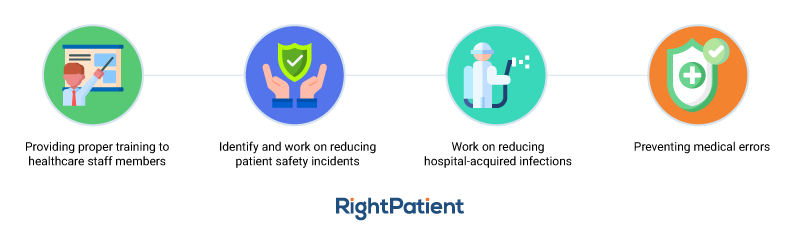
Providing proper training to healthcare staff members

One of the first tasks for patient safety quality improvement is to evaluate and identify which employees within your healthcare facility require training – they’re the ones dealing with the patients directly, after all. Whether it be nurses, registrars, patient safety professionals, or other staff, improving their skills can significantly improve patient safety. 

Use quizzes, short interviews, and their recent performance to identify the ones that require training regarding the do’s and don’ts and patient safety incidents. Ensure that they know the critical aspects that can make or break patient safety within your facility. 

Identify and work on reducing patient safety incidents

Patient safety incidents are ever-present in hospitals – they’re just waiting to happen unless addressed appropriately. Take a more proactive approach than a reactive one in identifying issues that might cause patient safety incidents down the line by conducting audits. While this might seem repetitive, it does ensure patient safety quality improvement and can help you avoid hefty costs in the process.

One belief many healthcare providers have is that conducting routine checks is enough. However, healthcare is a dynamic environment and there are new challenges every day that need to be addressed appropriately and in due time. Conducting checks regularly or whenever a serious incident occurs in your facility and monitoring to prevent these incidents using apps can also boost patient safety significantly.


4-strategies-for-patient-safety-RightPatient

Work on reducing hospital-acquired infections

During COVID-19, this is a strategy all healthcare providers must implement for patient safety quality improvement. Enforcing social distancing practices for everyone in the facilities is the only way to reduce transmission of infectious diseases. Ensure that people (both patients and healthcare staff members) are standing six feet apart, and use proper PPE. Moreover, provide sanitizers or handwashing facilities at crucial points to ensure better protection. Also, minimize or eliminate physical contact as much as possible, especially in registration areas for all incoming patients. Using a touchless patient identity verification platform can significantly help with improving hygiene, and in turn, patient safety.

Preventing medical errors

As previously mentioned, one of the biggest issues that cause patient safety incidents is medical errors, and most of these can be associated with patient misidentification, patient mix-ups, and duplicate medical records.

Imagine this – if a patient is misidentified right from the start, or is associated with an incomplete medical record, their entire treatment will be full of errors. Not only does this lead to wrong medications, but also leads to wrong transplants, longer hospital stays, readmissions, irreversible physical damage, and even deaths. Preventing medical errors, thus, becomes the topmost priority to enhance patient safety within hospitals – and that’s exactly what RightPatient does. 

Achieve patient safety quality improvement with RightPatient

RightPatient is a touchless biometric patient identification platform that is used by leading healthcare providers to identify their patients accurately at every interaction. By using patients’ photos, RightPatient identifies them accurately right from the start and across the care continuum, preventing duplicate medical records, patient safety incidents, and medical errors.

Are you a responsible healthcare provider that is working to enhance patient safety? Contact us now to learn how you can improve patient safety, and more, with RightPatient.

RightPatient-prevents-one-of-the-overlooked-clinical-trial-issues-professional-patients

Professional Patients Are One of the Overlooked Clinical Trial Issues – More Examples

RightPatient-prevents-one-of-the-overlooked-clinical-trial-issues-professional-patients

If you google the term “clinical trials” right now, you’ll see that virtually everyone is talking about them and are extremely interested in the topic. That’s because the pandemic has thrust the topic into the limelight, leading to even the average person talking about clinical trials. While most of the world is interested in clinical trials to learn about the vaccines that can combat the infamous virus, we’re here to talk about the efficacy and integrity of such studies. We’ve already covered how and why “professional patients” or “professional study subjects” are one of the less-discussed clinical trial issues. Today, let’s explore a few more real-life cases that support our claim and how effective patient identity management with RightPatient can prevent the participation of professional patients.

RightPatient-prevents-one-of-the-overlooked-clinical-trial-issues-professional-patients

Professional patients in clinical trials are one of the less-discussed issues.

Some examples to confirm professional patients are one of the hidden clinical trial issues

We’ve already talked about a case of a professional patient who falsified their information and participated in a few clinical trials. While the patient was in it for the money, let’s take a look at some other real-life cases.

A tale of lies

Patient Y had also participated in multiple clinical trials – three, to be precise, in a span of five years. According to her, these trials are short-term opportunities, and she turns down the ones that involve testing unproven drugs on her. The initial trial she participated in involved the use of a certain “botulinum toxin”, and while there wasn’t any payment involved, she got the treatment for free. 

The next trial patient Y participated in was about the study of the same toxin, and the research team took her blood sample, conducted an ECG, as well as other tests. This time, she did receive financial benefits – one of the incentives she searches for in trials. However, she provided incorrect information this time around – she decreased her age as well as lied when asked if she got Botox earlier or not (she did receive it in the first trial). She chose to get into the trial because she was getting paid and because she was getting free Botox. 

One glaring issue here is that even though the officials could have easily checked patient Y’s documents to verify her age, they didn’t, and she got to participate in the trial. This shows that not everyone who signs up as a participant is vetted thoroughly, which is why a robust patient identification solution is required – more on that later. Moreover, even though these professional patients are falsifying information to get into the trials, many of them believe that they are contributing to the medical community by being participants. Unfortunately, that is far from the truth, as they are part of one of the overlooked but crucial clinical trial issues that threaten the integrity of the studies.

Even regular test subjects know a few professional patients!

This case is different, as the patient involved, Z, never used any unlawful means to participate in trials, and even though he participated in some trials, he did so by complying with the rules and regulations.

However, patient Z did meet a number of patients who used misinformation and other means to participate in the trials, and according to him, they believe that the rules do not apply to them.

While patient Z participated for the financial benefits as well as helping advance medicine, he complied with all the rules and regulations. He used the compensation he received to pay off debts as well as support himself for around ten years – one of the trials that focused on Alzheimer’s paid him $31,000.

Moreover, as his grandmother has Alzheimer’s, patient Z feels that by participating in clinical trials to advance medicine that might be of use to her one day, he’s helping her.

“Professional patients” continue to be one of the overlooked clinical trial issues

As the above examples show, “professional patients”, “professional study subjects”, or “duplicate subjects”, whichever term use, still exist in clinical trials. They falsify information such as their age, identity, medical history, etc. to enroll in multiple trials simultaneously or consecutively. Doing so not only hampers their health and safety, but the safety of the other patients involved in the trials.

To make matters worse, their involvement skews the overall results of the research, leading to delaying the trials or even shutting them down due to undesirable but inaccurate information. Professional patients cause billions of dollars in losses, can lead to delayed approvals from regulatory agencies, and lead to wasted years of effort from sponsors, research teams, and CROs. These individuals must be eliminated from clinical trials right from the start – RightPatient can help with that.

Use RightPatient to prevent one of the overlooked clinical trial issues

RightPatient is a tried and tested solution in the U.S. – several healthcare providers are protecting millions of patients with it. It is a touchless biometric patient identification platform that uses patients’ photos to identify them accurately across the care continuum, and the same concept can be used for clinical trials. 

RightPatient can prevent the participation of professional patients in clinical trials by red-flagging individuals attempting to participate in either multiple trials or at different sites of the same trial. It helps improve the efficacy of clinical trials, remove any unwanted individuals that can skew the overall results, and protect the integrity of these trials.

Contact us now to learn how we can help protect your clinical trials from skewed results with our robust patient identification solution.

RightPatient-prevents-the-professional-patient-problem-in-clinical-trials

The Professional Patient Problem Still Exists in Clinical Trials – Are You Preventing Them?

RightPatient-prevents-the-professional-patient-problem-in-clinical-trials

We’ve been talking about clinical trials for some time now. Usually, we talk about how integral these studies are for discovering new drugs, devices, or treatments, and how their outcomes affect all our lives as well as healthcare in general. However, today we are focused on one of the overlooked issues – the professional patient problem, and how the long-standing issue continues to skew overall results.

That being said, let’s take a look at a real-life case of a professional patient that participated in multiple clinical trials, how their involvement and actions can hamper trials and cause billions in losses, and how a patient identity verification platform like RightPatient can help prevent their participation.

The professional patient problem is very real – a recent example

A case that occurred in 2019 in Louisiana

At the end of 2019, patient X had signed up for a clinical study for asthma. While she was accepted into the trial like most of the individuals that volunteered for it, she had falsified some of her information to make herself appear eligible for the trial. 

There was a prerequisite stating that the subjects shouldn’t have had a certain steroid within the past two to three weeks. However, patient X did take it only a few days before signing up for the trial, and when she was asked, she flat-out denied taking it, as per Medscape Medical news. Unfortunately, she did make it into the trial, and her statement regarding her use of the steroid wasn’t verified.

However, that was just one clinical trial patient X participated in – there’s more. Otherwise, this wouldn’t have been an example of the professional patient problem!

Same professional patient, different study

Patient X participated in an entirely different study on nasal polyps, and in this case, she once again provided misleading information. While the trial focused on reducing nasal polyps using a certain spray, patient X was already using the same medication, but she informed the officials that she wasn’t. The study compensated her handsomely, which is why she was tempted to falsify information.

But what did the officials do to verify her information? 

They requested a note from her physician, checked her driver’s license, required access to her patient portal, and viewed photos of her medications, among other things. Even then, they couldn’t detect the fact that she falsified information to sign up for the clinical trial. 

RightPatient-prevents-duplicate-subjects-in-clinical-trials

Professional patients skew overall results and delay effective trials

The tale of patient X is not a rare incident, unfortunately. These cases are examples of the professional patient problem, and they occur too often to be ignored. The participation of these individuals is a significant blockage to carrying out clinical trials effectively, and more often than not, these cases are discovered only when it’s too late. Their involvement in the trials affects data significantly and might cause even promising drugs to be delayed or even announced to be ineffective. Not only does their participation cause promising drugs to not see the light of day, but it also causes much-needed breakthroughs in medicine to be delayed. These are the consequences of professional patients falsifying data, participating in multiple trials simultaneously or consecutively, and faking results, and might cause trials to not proceed to the subsequent phase(s). As a result, the participation of professional patients, or “professional study subjects”, must be eliminated.

Fortunately, professional patients in clinical trials can be prevented with RightPatient.

RightPatient helps combat the professional patient problem

A touchless biometric patient identification platform, RightPatient has been helping responsible healthcare providers prevent scammers from using healthcare services within their facilities. The platform identifies patients using their photos that are taken during registration and prevents fraudsters from assuming the identities of registered patients – it can do the same for clinical trials too. 

RightPatient can help maintain a database of the registered patients in clinical trials at multiple sites, and whenever a fraudster or these professional patients try to sign up, the platform can red-flag them – saving billions, protecting the integrity of your trials, and preventing delays.

Use RightPatient now to see how it can ensure that your investments are protected and improve the efficacy of your clinical trial(s).